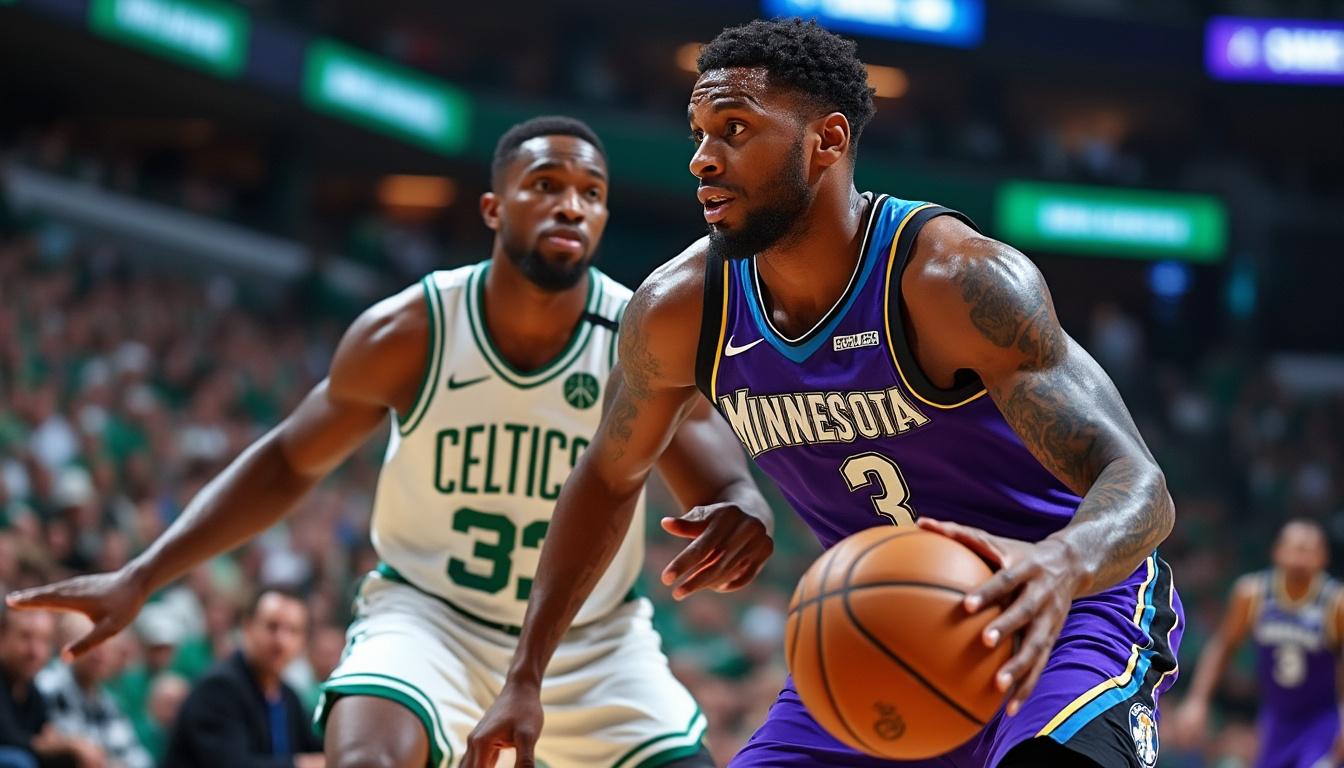
The clash between the Minnesota Timberwolves and the Boston Celtics on November 29, 2025, was a vivid illustration of basketball’s magnetic appeal, blending fierce defense and high-octane offense. At the Target Center in Minneapolis, the Wolves, prioritizing tenacious defense, confronted the Celtics, a team regarded as one of the league’s premier title contenders. Both teams entered the game with identical records of 10-8, setting the stage for a showdown that could redefine the trajectory of their seasons. This encounter wasn’t just a regular season game but a true test of the Celtics’ championship credentials against a Wolves squad eager to break free from a three-game losing streak.
From the tip-off, Minnesota imposed its style—defense first—with Anthony Edwards leading the charge. Edwards showcased his immense scoring ability with a dazzling 39-point performance, including a clutch three-pointer that ultimately sealed the game 119-115 in favor of the Wolves. Meanwhile, Boston’s Jaylen Brown fought valiantly, scoring 41 points, spearheading the Celtics’ offensive efforts. However, the Wolves’ defensive resilience constantly challenged Boston’s usual fluidity. This defensive pressure, combined with strategic game management and timely shooting, especially from Anthony Edwards and Donte DiVincenzo, kept the Celtics on their toes throughout the contest.
Against the backdrop of November’s tightening NBA race, this game provided critical insights into how defense can disrupt even the most potent offenses. The Celtics’ title hopes now face a serious evaluation after they’ve been put to the test by a Wolves team not traditionally known for elite defense. The stakes were high, and the atmosphere electric, with more than 17,000 fans witnessing a basketball spectacle where every possession mattered. Indeed, this game was a microcosm of the 2025 NBA season — a battle of grit, style, and determination, perfectly captured under the roaring lights of the Target Center.
For those tracking the evolving NBA landscape, understanding this matchup offers a window into how the Wolves’ defense can potentially redefine their future games and how the Celtics must adjust if they wish to maintain their march toward NBA glory. Fans looking to watch similar thrilling basketball moments should explore the latest NBA and Euroleague streaming options for comprehensive access to high-profile games.
As the Timberwolves snapped their losing streak and sent a message across the league, the impact of this defense-first approach was undeniable—showcasing the timeless truth of basketball that defense wins games, especially when set against teams with legitimate title aspirations.
In brief:
- The Minnesota Timberwolves showcased a staunch defense that challenged the Boston Celtics’ offensive power, leading to a 119-115 victory.
- Anthony Edwards was the standout performer, scoring 39 points and hitting the game-winning three-pointer.
- Despite Jaylen Brown’s 41 points, the Celtics struggled to overcome the Wolves’ defensive pressure.
- Both teams entered the match with 10-8 records, making the outcome significant for their playoff positioning.
- The game acted as a litmus test for the Celtics’ title credentials in a fiercely competitive NBA season.
Analyzing the Minnesota Timberwolves’ Defense: The Backbone of Victory Over Boston Celtics
The Minnesota Timberwolves’ defense became the backbone of their triumph over the Boston Celtics on November 29, 2025. This approach was not just a tactical choice but a vital response to their earlier struggles in the season and the need to halt a three-game losing streak. The Wolves showed how prioritizing defense can disrupt one of the league’s top offensive units, testing the Celtics’ ability to adapt under pressure.
Entering this matchup, the Wolves were averaging a middling defensive rating. However, on this night, they elevated their intensity dramatically. The game’s statistics emphasize this shift—while Boston shot a respectable 47% from the field, their three-point shooting dipped to 35%, a figure notably below their season average. Minnesota, on the other hand, excelled from long range at 44%, highlighting how the Wolves balanced defense with opportunistic offense.
Anthony Edwards was crucial not only for his scoring output but for his defensive tenacity, frequently pressuring Celtics’ guards and wings. His ability to anticipate passes and disrupt offensive sets frustrated Boston’s rhythm. Complementing Edwards was Rudy Gobert, who anchored the paint with multiple block shots and rim protection plays. Gobert’s presence demanded Celtics players to rethink their drives and shots near the basket, contributing directly to the Timberwolves’ 37 rebounds, limiting Boston’s second-chance opportunities compared to their 43 boards.
This shift toward defense-first is illustrated by a few key elements:
- Switching and rotation efficiency: Minnesota’s defensive switches on pick-and-rolls minimized open looks.
- Pressure on the perimeter: The Wolves applied relentless ball pressure to contest Celtics’ three-point shooters.
- Rim protection: Gobert and Neemias Queta altered several Boston shots inside.
- Defensive rebounding: Cutting off second chances and controlling the glass.
- Versatility in guarding multiple positions: Giving the Wolves flexibility to counter Boston’s dynamic lineup.
Together, these factors created a fortress around the Timberwolves’ home court at Target Center, pushing the Celtics to adapt their usual fast-paced style and forcing them into difficult scoring situations. The Wolves’ defensive execution showed a blend of discipline and aggression that basketball purists admire.
| Team | Field Goal % | Three Point % | Turnovers | Rebounds |
|---|---|---|---|---|
| Boston Celtics | 47% | 35% | 11 | 43 |
| Minnesota Timberwolves | 49% | 44% | 15 | 37 |
The Timberwolves’ defensive success was a testament to a collective effort built on team communication and physicality. This game represents a strategic evolution for a squad still on its way up in the competitive Western Conference. Fans curious about such evolving tactics can also find insights in the context of NBA contenders’ momentum as teams fight for playoff spots.
Boston Celtics’ Offensive Challenge Under Minnesota’s Defensive Pressure
The Boston Celtics, widely regarded as a strong title contender, were thrust into a stern test by the Timberwolves’ staunch defense. Jaylen Brown’s 41-point performance was a highlight reel of resilience, showcasing his scoring versatility from step-back jumpers to hard drives. Yet, on this night, he was often met with tough defenders and frequent double-teams, limiting the smooth flow that characterizes Boston’s offense.
Boston’s offense depends heavily on ball movement, spacing, and exploiting defensive lapses. Against the Wolves, however, their usual rhythm was disrupted. The team committed 11 turnovers compared to Minnesota’s 15, suggesting Minnesota’s defense not only forced errors but also limited the high-quality shot opportunities the Celtics seek. This forced adaptation under pressure brought into sharp focus the challenges that even elite teams face against well-coordinated defenses.
Several factors contributed to Boston’s offensive difficulties:
- Shot contesting by Wolves defenders: Celtics shooters often faced tight coverage on three-point attempts, reflected in the lower 35% shooting.
- Limited second chances: Timberwolves’ defensive rebounding denied Boston additional scoring opportunities.
- Defensive switches on pick-and-rolls: Wolves’ defenders aggressively rotated, disrupting passing lanes and ball handler comfort.
- Pressure on playmakers: Donte DiVincenzo actively harassed Boston’s ball handlers, making it hard for the offense to find a consistent rhythm.
- Fatigue and high-stakes pressure: The intense defensive effort extended over four quarters, stretching Boston’s stamina and focus.
Despite these hurdles, Boston showed moments of brilliance. Their ability to adjust and find scoring even in tight circumstances highlighted why they remain legitimate championship contenders. The team’s depth also featured contributions from Julius Randle, who had impressive moments with several critical assists and mid-range shooting. Yet, their performance underscores that title aspirations require both offensive firepower and an adaptable defensive game plan.
| Boston Celtics Player | Points Scored | Field Goals Made/Attempted | Three Pointers Made | Assists |
|---|---|---|---|---|
| Jaylen Brown | 41 | 17/32 | 4 | 5 |
| Julius Randle | 23 | 9/20 | 3 | 7 |
| Donte DiVincenzo | 18 | 7/15 | 5 | 4 |
The question remains whether the Celtics can replicate this intensity over the long haul of the NBA schedule or if they need to tweak their approach to counter defenses as rugged as Minnesota’s. Fans and analysts eager to learn more about the strategic challenges faced by NBA elites can broaden their perspective through resources such as the November 2025 NBA injuries report, which shows how teams adapt during critical moments.
Anthony Edwards’ Impact: Scoring and Defensive Mojo Against Boston
Anthony Edwards emerged as the figurative and literal star of this matchup. Scoring 39 points — an infectious combination of aggressive drives, precise shooting, and clutch decision-making — Edwards epitomized what it means to lead by example. His stat line is impressive: 12 field goals on 24 attempts and near-perfect free throw shooting at 10 for 11. Beyond scoring, Edwards’ defensive contributions were equally vital.
Edwards’ knack for timely blocks, steals, and intelligent rotations played a significant role in disrupting the Celtics’ offensive plans. His relentless energy and solid defense on Boston’s backcourt players showcased that offense-defense duality that increasingly defines NBA superstars. His willingness to take and make pressure shots, capped by a high-difficulty three-pointer late in the fourth quarter, underscored his importance on both ends.
- Offensive versatility: Edwards scored from inside and beyond the arc, showing a full offensive repertoire.
- Defensive hustle: Key blocks and steals shifted momentum crucially.
- Leadership under pressure: Clutch plays demonstrated mental toughness.
- Complementary playmaking: Assisted teammates and fostered team synergy.
- Physical conditioning: Maintained a high level of energy despite a grueling game pace.
Edwards’ performance was a microcosm of Minnesota’s defense-first identity this game—a team effort fueled by one extraordinary player’s excellence. Observers interested in a closer look at Edwards’ evolving role among rising NBA stars in 2025 will find this game illustrative of his growing dominance.
Strategic Implications for the Season: Wolves Defensive Model Against Top Contenders
This game offers a valuable case study in strategic evolution within the NBA landscape. The Minnesota Timberwolves, traditionally viewed as an offensively driven team, displayed a newly minted defensive identity capable of taking down premier teams like the Boston Celtics. This strategic shift could shape their success trajectory through the rest of the 2025 season and beyond.
Given the competitiveness in the NBA’s Northwest Division and the league overall, defense is a critical differentiator. The Timberwolves’ ability to raise defensive intensity on the big stage is a blueprint for success that other contenders should heed. Teams vying for championships increasingly recognize the value of a robust defense combined with electric offense. This balanced blueprint was on full display during this riveting game.
Several strategic takeaways from Minnesota’s defensive game plan include:
- Investing in rim protection: Rudy Gobert’s presence prevented high-percentage shots close to the basket.
- Defensive versatility: Multiple players can switch effectively on defense, keeping offenses guessing.
- Ball pressure on shooters: Forcing contested jumpshots from usually reliable three-point shooters.
- Transition defense: Proper defensive rotations reducing fast break opportunities for opponents.
- Psychological edge: Intimidation through physicality and communication on defense.
| Strategic Element | Example in Game | Potential Season Impact |
|---|---|---|
| Rim Protection | Rudy Gobert’s multiple blocks and altered shots | Higher defensive efficiency and reduced opponent scoring near basket |
| Defensive Switching | Seamless rotations guarding Boston’s pick-and-roll | Limits open shots and forces lower quality attempts |
| Perimeter Pressure | Harassing Celtics’ three-point shooters | Reduces opponent shooting percentage and rhythm |
| Transition Defense | Quick defensive recoveries and rotations | Limits points off fast breaks, key in close games |
| Psychological Edge | Consistent physicality and communication | Intimidates opponents and boosts team cohesion |
For those diving deep into NBA tactics and betting angles, understanding defense-first strategies like Minnesota’s is crucial. Resources like the NBA betting probe in 2025 provide enhanced analytics and projections that inform how such games can influence playoff odds and team trajectories.
Fan Perspectives: The Emotional Rollercoaster of Timberwolves vs Celtics Showdown
For fans witnessing this encounter live at the Target Center or through broadcasts, the game was an emotional rollercoaster blending tension, hope, and exhilaration. The ebb and flow of lead changes saw the crowd erupt at key moments, especially when Anthony Edwards nailed the improbable game-winning three-pointer. It’s this kind of high-stakes drama that makes basketball not just a sport but a shared cultural experience.
Key aspects that made this game memorable to fans are:
- Close final score: The game’s 119-115 finish ensured excitement up to the last possession.
- Star performances: Edwards and Brown lighting up the scoreboard kept fans fully engaged.
- Defensive hustle: Fans appreciated the physicality and strategic integrity.
- Atmospheric energy: The thunderous crowd of over 17,000 amplified the game’s intensity.
- Implications for playoff races: With both teams holding 10-8 records, the stakes felt season-defining.
These electrifying moments push fans to deepen their appreciation for the game, motivating some to explore additional basketball opportunities, including best basketball shoes for guards or following global basketball updates to feed their passion.
| Fan Aspect | Impact | Lasting Effect |
|---|---|---|
| Close Score | Kept fans on the edge of seats | Memorable nail-biter enhancing fan loyalty |
| Star Duels | Highlighted player rivalries | Raised anticipation for future matchups |
| Defensive Intensity | Showcased team grit | Boosted appreciation for strategic basketball |
| Atmosphere | High-energy crowd engagement | Promoted home court advantage awareness |
| Playoff Implications | Raised game stakes | Enhanced season narrative |
Moments like these highlight why basketball transcends simple competition; it becomes a lifestyle, a spectacle, and a community. For more about current global basketball action and stories, enthusiasts can visit global basketball news hubs that keep the sport alive year-round.
How did Minnesota Timberwolves’ defense limit the Boston Celtics?
The Timberwolves applied intense ball pressure, efficient switching, rim protection, and defensive rebounding that disrupted the Celtics’ usual offensive flow and limited their scoring opportunities.
What made Anthony Edwards’ performance stand out in this game?
Edwards combined prolific scoring with defensive effort, including clutch shots and key blocks, demonstrating a dual impact on offense and defense that was pivotal in Minnesota’s victory.
Why is this game important for the Celtics’ title credentials?
As a top NBA contender, the Celtics faced a tough test that exposed their vulnerabilities under defensive pressure, challenging them to adjust strategies if they want to sustain championship-level performance.
What strategic lessons can other NBA teams learn from Minnesota’s defensive approach?
Investing in rim protection, effective defensive switching, perimeter pressure, and cohesive team communication are crucial strategies demonstrated effectively by the Timberwolves in this game.
Where can fans watch more NBA basketball games similar to this?
Fans can explore a variety of NBA and international basketball streaming platforms, including NBA and Euroleague streaming services for live and on-demand basketball content.